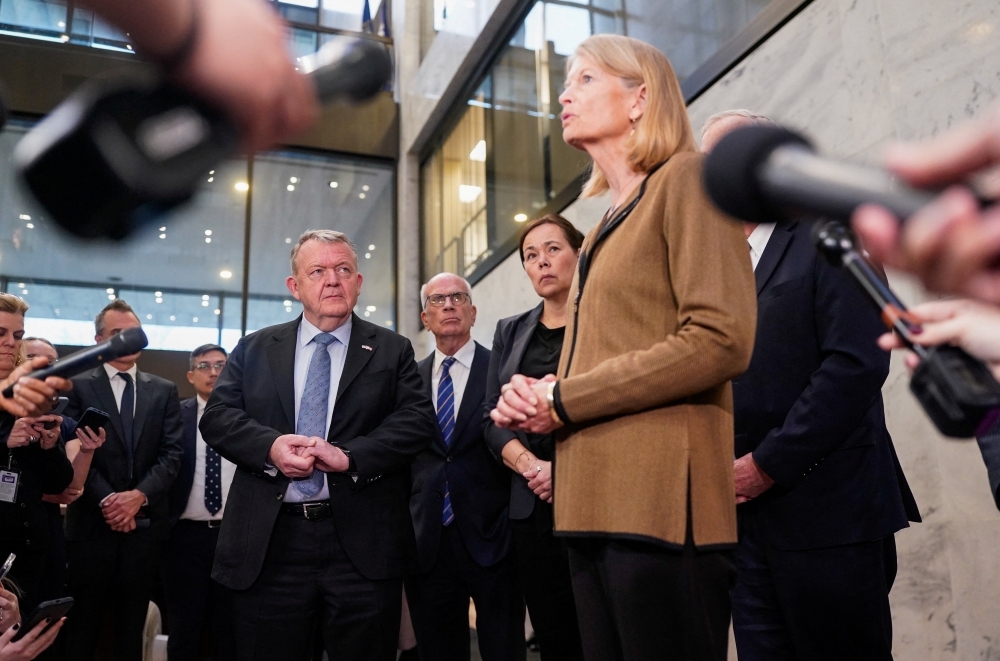
A tense White House meeting yesterday between US and Danish officials did little to ease the growing friction over Greenland, as President Donald Trump reaffirmed his desire to bring the Danish territory under American control.
Danish Foreign Minister Lars Løkke Rasmussen and Greenlandic counterpart Vivian Motzfeldt met with US Vice President JD Vance and Secretary of State Marco Rubio. While the sides agreed to form a working group to discuss concerns about the island, Rasmussen stressed that Washington’s position remained unchanged. “We didn’t manage to change the American position,” he told reporters. “It’s clear that the president has this wish of conquering Greenland.”
Trump has repeatedly argued that Greenland’s strategic location and mineral wealth make it vital to US security. He claims the US must secure the territory to prevent Russia or China from gaining influence, sparking unease among NATO allies. Before the meeting, Trump even tweeted that NATO would be stronger if Greenland were in US hands, warning that anything less was “unacceptable.”
Denmark and Greenland, however, insist the island is not for sale. They have begun strengthening military presence in the Arctic alongside NATO allies, emphasizing that threats of force are dangerous and unnecessary. Rasmussen and Motzfeldt described the White House meeting as respectful but firmly rejected US ownership. “It is not a true narrative that we have Chinese warships all around the place,” Rasmussen said.
For many in Greenland, the news is personal. Liv Aurora Jensen, a designer in Nuuk, described her anxiety ahead of the press conference: “I have been sleeping very, very badly. I was telling my sister yesterday, ‘I’m trying not to get a panic attack.’” Analysts note that Denmark and Greenland were wary of being publicly humiliated at the White House, recalling how Ukrainian President Zelenskiy faced criticism in a prior meeting with Trump.
Greenlandic leaders have also taken a careful stance. While the island has long discussed paths to independence, current statements highlight unity with Denmark. Prime Minister Jens-Frederik Nielsen told Sermitsiaq: “It’s not the time to gamble with our right to self-determination, when another country is talking about taking us over… Here and now we are part of the kingdom, and we stand with the kingdom.” Motzfeldt echoed that message, affirming Greenland’s current bond with Denmark.
European allies have voiced strong support for Denmark and Greenland. European Commission President Ursula von der Leyen assured Greenlanders that they could count on EU backing, while French President Emmanuel Macron warned that undermining the sovereignty of a European ally could have “unprecedented” consequences.
A poll in the US also shows little public support for Trump’s ambitions: only 17% of Americans favor the move, while a majority oppose using force to acquire the island.
As Greenland and Denmark navigate this geopolitical tension, locals and leaders alike are bracing for a long and uncertain road. The island’s future remains firmly in their hands — and for now, they are choosing unity, security, and sovereignty over foreign ambition.