
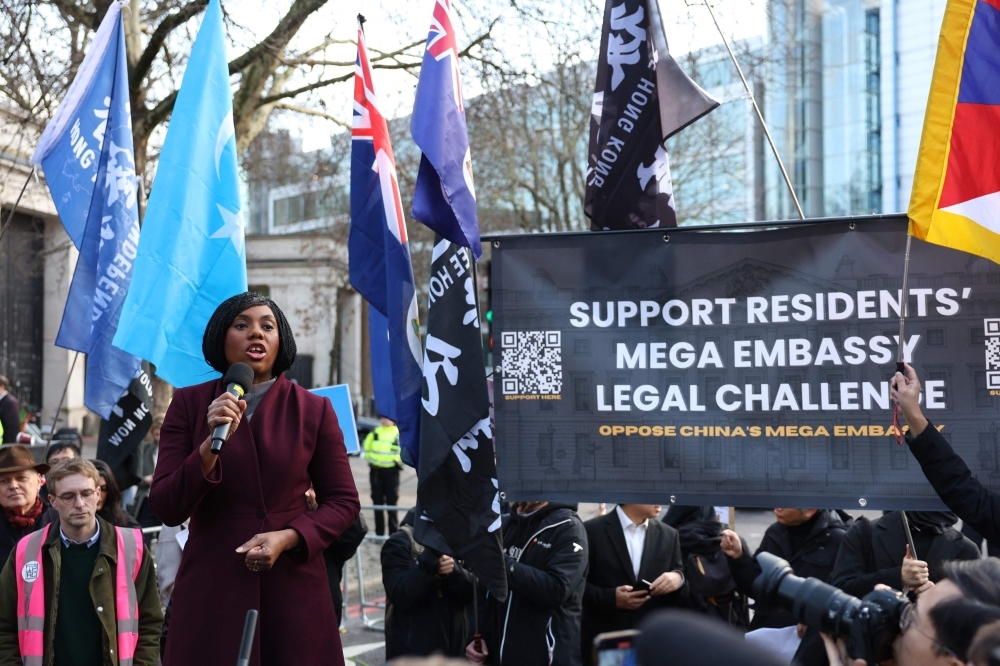
Hundreds of Londoners gathered on Saturday to protest Beijing’s controversial new “mega” embassy, just days before a crucial decision is expected on the project.
Masked and determined, protesters chanted “No to Chinese embassy” and waved banners reading “Free Hong Kong. Revolution Now.” Some held placards declaring, “MI5 warned. Labour kneeled,” pointing to UK intelligence concerns and the government’s stance. Others warned, “CCP is watching you. Stop the mega embassy.”
For several years, China has sought to relocate its embassy from Marylebone to a sprawling historic site near the Tower of London. The proposed move has drawn fierce opposition from local residents, human rights organizations, and critics of the Chinese Communist Party (CCP).
The protest comes ahead of the expected government decision later this week.
Human Rights Warnings
Benedict Rogers, head of Hong Kong Watch, said that if the plan is approved, the embassy site is “highly likely” to be used for espionage, given its proximity to sensitive underground communications cables. He added that Beijing’s campaign of transnational repression against diaspora communities would likely escalate if the new embassy were built.
Voices from the Diaspora
Brandon, a 23-year-old bank employee from Hong Kong living near Manchester, told the crowd the plans raised “a lot of concerns.” He said many Hong Kongers moved to the UK to escape authoritarian rule, only to face the possibility of a Beijing “operations base” in London.
“I don’t think it’s good for anyone except the Chinese government,” Brandon said.
Another protester, a 60-year-old warehouse worker originally from Hong Kong, echoed these fears, urging Prime Minister Keir Starmer to halt the project due to national security risks for both the UK and Europe.
Political Response and Security Concerns
Conservative Party leader Kemi Badenoch and other British MPs joined the protest in voicing serious security concerns. Earlier reports revealed that the embassy’s plans could include 208 secret rooms, including a concealed chamber beneath the site, located near critical communications infrastructure. The Daily Telegraph reported that unredacted plans for the new embassy show Beijing’s intention to incorporate hidden rooms potentially usable for surveillance.
As Londoners continue to raise their voices, the debate highlights a complex balance between diplomatic development and security, while giving those most affected—diaspora communities—a platform to express their fears.
In the words of many protesters, this is more than an embassy issue; it’s about safeguarding freedoms and protecting communities from hidden risks.