
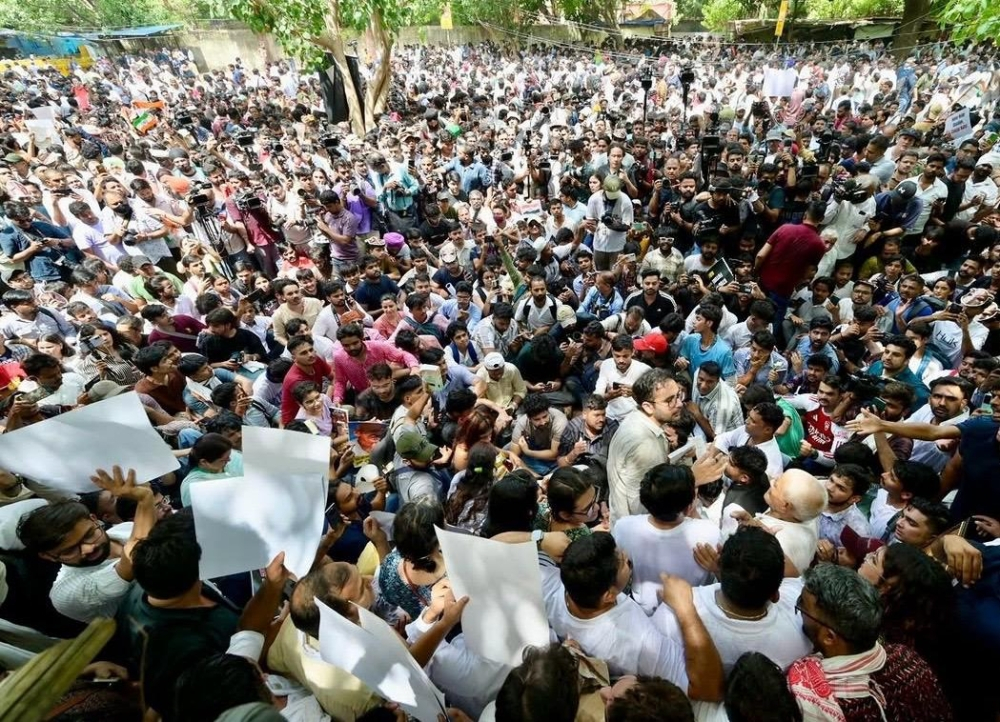
Authorities in New Delhi stepped up security on Saturday as preparations intensified ahead of a planned street protest by a satirical political movement known as the “Cockroach Janta Party” (CJP), which has drawn massive attention online and sparked fresh debate around youth frustration and exam system controversies in India.
Police deployed steel barricades, riot control vehicles, and detention vans across key areas of the capital, including near the airport and the well-known protest hub Jantar Mantar, in anticipation of possible large gatherings.
The CJP, a parody movement inspired by India’s ruling Bharatiya Janata Party (BJP), has rapidly gained traction on social media since its emergence last month. The group claims to represent young people frustrated with alleged irregularities in competitive examinations, including paper leaks and technical disruptions that have affected students across the country.
Its rise was fueled in part by controversy surrounding remarks allegedly made by India’s Chief Justice Surya Kant during a court hearing, where he reportedly referred to government critics as “cockroaches” and “parasites.” The comments triggered widespread backlash among young people online, although the judge later stated that his remarks were misinterpreted.
Positioning itself as a youth-driven movement, the CJP has adopted the slogan calling itself “a political front for the youth, by the youth, for the youth,” resonating strongly with a digitally active generation.
CJP founder Abhijeet Dipke, a 30-year-old former political communications strategist who previously worked with the opposition Aam Aadmi Party (AAP), returned to India from the United States on Saturday morning. He had earlier announced plans to seek police permission for what he described as a peaceful protest.
In his public statements on social media, Dipke emphasized non-violence, writing that the movement must be guided by “love and peace.” He has also called for the resignation of Education Minister Dharmendra Pradhan, who has faced criticism over ongoing concerns about exam management, including alleged leaks and administrative failures.
Despite India’s strict digital regulations, the movement’s online presence continues to grow. While several CJP accounts have been restricted, its Instagram page remains active in India and has reportedly attracted over 22 million followers, surpassing the online reach of major political parties.
The Bharatiya Janata Party has around nine million Instagram followers, while the Indian National Congress has approximately 13 million, highlighting the unexpected digital influence of the satirical group.
Security remains heightened across the capital, with authorities closely monitoring movement at protest sites and transport hubs. Officials have not commented publicly on whether permission for the demonstration has been formally granted.
The emergence of CJP also reflects deeper concerns among India’s youth, many of whom continue to struggle with unemployment and intense competition for stable jobs despite the country’s rapid economic growth. Analysts say such frustrations are increasingly finding expression through digital activism and unconventional political movements.