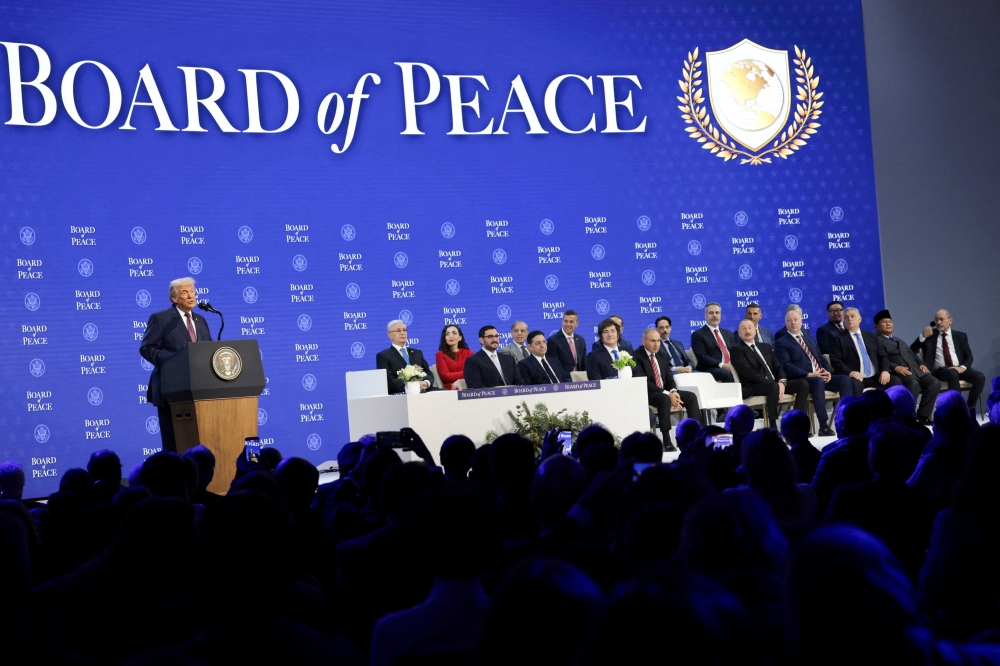
US President Donald Trump hosted a major diplomatic gathering in Washington this week to officially launch his new global initiative called the “Board of Peace.” While the immediate spotlight was on Gaza, the scope of the project stretches into wider global security concerns.
About two dozen world leaders and senior officials attended — a mix that included several of Trump’s political allies and notable absences by many traditional European partners. This underscored the unique diplomatic alliance shaping around the new board.
The Board of Peace was born out of recent diplomatic efforts, including a truce negotiated last October between Israel and Hamas with help from the United States, Qatar and Egypt. U.S. officials now describe the initiative as entering a second phase, with a shift toward disarming Hamas — the armed Palestinian group whose attack on Israel in October 2023 ignited a devastating conflict.
According to Gaza’s health ministry, at least 601 people have died in Israeli operations since the truce began, highlighting the fragility of the ceasefire and the urgency for stable agreements.
At the summit, Trump outlined pledges exceeding US$5 billion (approximately RM19.6 billion) to help rebuild Gaza’s shattered infrastructure — much of which lies in ruins after years of fighting. Trump also floated ambitious ideas for future development, including the possibility of resort projects in the region.
A major focus for the board will be creating an International Stabilization Force to support peace and security in Gaza. Indonesia, the world’s largest Muslim-majority country, has emerged as a key potential contributor, expressing readiness to send up to 8,000 troops if the force is approved. Indonesian President Prabowo Subianto joined the summit after participating in the World Economic Forum in Davos last month.
Debates on Disarmament and Governance
U.S. officials — including negotiator Steve Witkoff — say progress is being made and that Hamas is feeling pressure to relinquish weapons. Israel has called for broad weapons restrictions, emphasizing the removal of small arms such as AK‑47 rifles as part of disarmament efforts.
Experts emphasize that removing weapons from Hamas won’t be simple, and success will depend on a clear, credible plan that has buy‑in from all parties involved.
Alongside security talks, a technocratic committee was recently set up to oversee day‑to‑day governance in Gaza, led by engineer and former official Ali Shaath.
Hamas, through spokesman Hazem Qassem, criticized the Board of Peace, urging the initiative to pressure Israel to end what it calls violations and to lift its blockade of the Gaza Strip.
Trump’s Vision and International Reactions
The meeting took place inside the U.S. Institute of Peace building — a long‑standing conflict resolution institution that had faced staffing cuts under Trump, with the president later placing his own name on the entrance.
Under the White House plan, Trump would have veto power over board decisions and could remain its head even after leaving office. Countries wanting a permanent seat would be expected to commit US$1 billion, while others join for two‑year terms.
While U.S. officials insist the board will focus on Gaza, they also describe it in broader, sometimes unclear terms, saying it could tackle other global hotspots. Some analysts have criticized the initiative as driven more by personal ambition than cohesive strategy.
The launch also reflected Trump’s strained relationship with the United Nations, as the U.S. has reduced funding and withdrawn from several key UN bodies over recent years.
Who Attended — and Who Didn’t
The summit drew several leaders aligned with Trump’s foreign policy stance, including Hungarian Prime Minister Viktor Orban and Argentinian President Javier Milei. Other attendees, such as Pakistani Prime Minister Shehbaz Sharif, took part partly to strengthen bilateral ties.
However, many longtime U.S. allies were absent. France and Canada chose not to participate, while Japan sent a special envoy focused on Gaza. Brazilian President Luiz Inacio Lula da Silva declined the invitation altogether, arguing that there should be a seat for Palestine and critiquing the board as overly centered on Trump’s leadership.
Lula described the Board as “a new UN where only he is the owner,” reflecting some of the global skepticism about the initiative’s legitimacy and reach.