
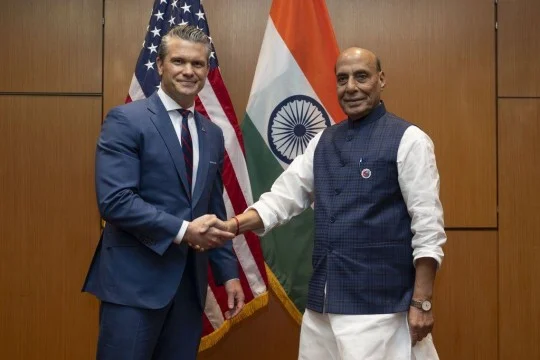
The United States’ annual defence policy bill has highlighted a stronger focus on expanding ties with India, signaling Washington’s intent to collaborate more closely through platforms like the Quad. The move underscores a shared goal between the two democracies: a free and open Indo-Pacific region and addressing the challenges posed by China’s rising influence.
Released on Sunday, the National Defence Authorization Act (NDAA) for Fiscal Year 2026 emphasizes the “sense of Congress on Defence Alliances and Partnerships in the Indo-Pacific region.” It urges the Secretary of Defence to continue strengthening US defence alliances to enhance America’s strategic advantage in the region.
The bill specifically calls for broadening engagement with India through both bilateral and multilateral channels. This includes participation in military exercises, expanded defence trade, collaboration on humanitarian aid and disaster response, and closer maritime security cooperation.
The Quad, which brings together India, the US, Japan, and Australia, was formed in 2017 to address China’s aggressive activities in the Indo-Pacific. The NDAA also mandates the creation of a security initiative that strengthens cooperation among the defence industrial bases of the US and its regional allies, ensuring supply chain security, resilience, and interoperability. Participating countries may include Australia, Japan, South Korea, India, the Philippines, and New Zealand.
A notable inclusion in the bill is a joint assessment on nuclear liability rules between the US and India, which will be facilitated through the US-India Strategic Security Dialogue. This mechanism will regularly assess how India’s domestic nuclear liability rules align with international norms and develop strategies for diplomatic engagement on nuclear cooperation. Reports on this assessment are to be submitted within 180 days of the bill’s enactment and annually for the following five years.
By focusing on defence, trade, nuclear cooperation, and multilateral partnerships, the US signals that India remains a key partner in maintaining stability and security in the Indo-Pacific. This legislative step reflects not just strategic calculations but a growing recognition of India’s global role.
In a broader sense, this bill is more than just policy—it is a signal of friendship and shared responsibility. For India, it’s a step toward deepening ties with the US, boosting its defence capabilities, and contributing to regional stability. For citizens, policymakers, and businesses, it reinforces the notion that strong international partnerships are vital in today’s interconnected world.