Iran is preparing for the burial of its late Supreme Leader, Ali Khamenei, in the holy city of Mashhad, while renewed US military strikes have heightened fears of another dangerous escalation across the Middle East.
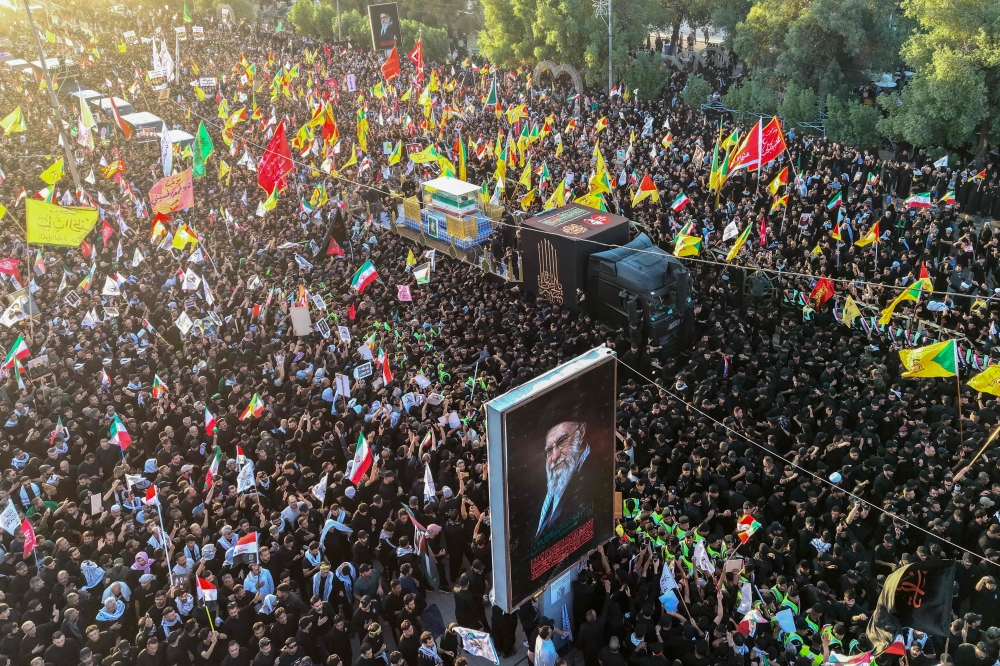
The funeral marks the final stage of several days of mourning that drew millions of people across Iran and Iraq. Large crowds gathered to pay tribute as the country bid farewell to one of its most influential political and religious leaders.
At the same time, regional tensions have sharply increased after the United States launched fresh strikes against Iranian targets. The military action came in response to attacks on commercial shipping in the strategically important Strait of Hormuz, one of the world’s busiest energy trade routes.
US President Donald Trump warned that stronger military action could follow if Iran continues targeting vessels passing through the waterway, adding further uncertainty to an already fragile regional situation.
Ali Khamenei was killed on February 28 during the opening day of the conflict involving US and Israeli military operations. His death marked a major turning point in the crisis, leaving Iran facing both national mourning and political uncertainty.
Before reaching his final resting place in Mashhad, Khamenei’s funeral procession traveled through several cities of deep religious significance. Ceremonies were held in Tehran before continuing to the holy city of Qom, followed by Najaf and Karbala in Iraq, where thousands gathered to pay their final respects.
Authorities expect an extraordinary turnout for the burial ceremony. Mashhad Governor Hassan Hosseini stated that as many as 15 million mourners could attend the funeral, making it one of the largest public gatherings in the country’s modern history.
The burial will take place at the Shrine of Imam Reza, Iran’s most sacred religious site and the resting place of the eighth Shia Imam. The shrine has long served as the burial place for many prominent Iranian political and historical figures, including former President Ebrahim Raisi and several former monarchs.
According to Iranian officials, Khamenei had personally expressed his wish to be buried in Mashhad, reflecting the city’s immense religious importance within Shia Islam.
The funeral ceremonies have also attracted attention for another reason. Many observers continue watching for any public appearance by Mojtaba Khamenei, the late leader’s son and widely discussed potential successor. Reports suggest he was injured during the same attack that claimed his father’s life, though he has yet to appear publicly.
The Islamic Republic hopes the nationwide funeral ceremonies will demonstrate unity and resilience during one of the country’s most challenging periods. The events come only months after widespread anti-government protests and amid ongoing regional instability.
Meanwhile, hopes for lasting peace remain uncertain. Although an earlier ceasefire and diplomatic efforts had temporarily eased hostilities, the latest exchange of military strikes has once again placed the region on high alert.
US Central Command stated that its recent operations were intended to reduce Iran’s ability to threaten international shipping through the Strait of Hormuz. Iran, in turn, said it had launched attacks against US military bases in Bahrain and Kuwait, further increasing fears of a broader regional confrontation.
Ali Khamenei, who led Iran from 1989 until his death at the age of 86, will be buried alongside several close family members who also lost their lives during the February 28 strikes, including his infant granddaughter, daughter, son-in-law, and Mojtaba Khamenei’s wife, Zahra Haddad Adel.
As the burial ceremony concludes, the Middle East enters another uncertain chapter. With diplomatic efforts under pressure and military activity continuing on multiple fronts, world leaders are closely monitoring developments in hopes of preventing a wider regional conflict.