As the war in Ukraine continues to reshape the security landscape of Europe, Ukrainian President Volodymyr Zelensky arrived in the United Kingdom for high-level discussions with key European allies following a new wave of Russian attacks that left several people dead and caused damage to a nuclear-related facility near the Chernobyl exclusion zone.
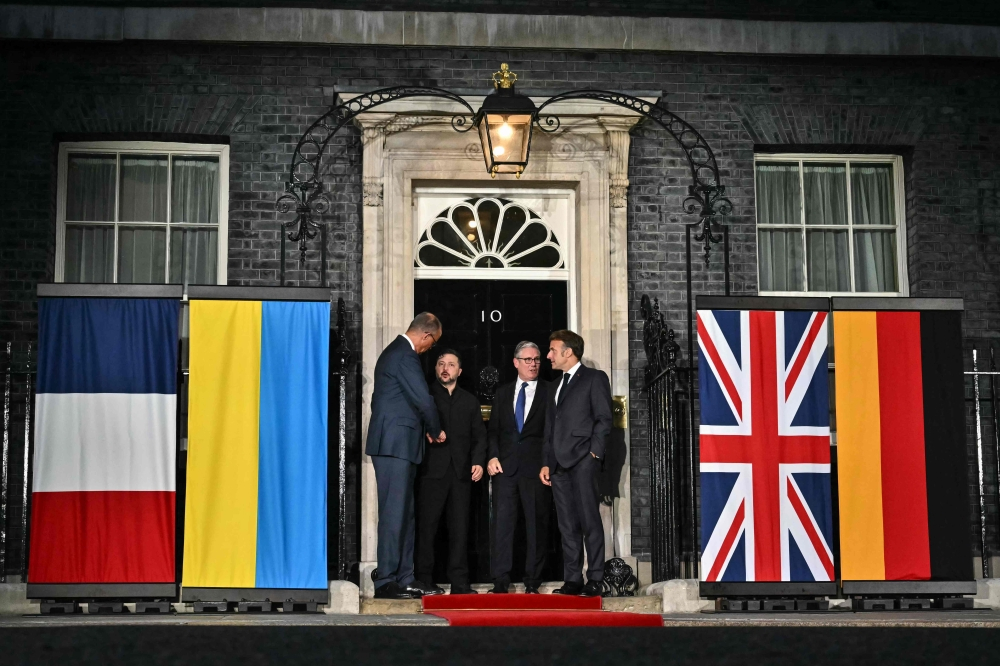
Upon his arrival in London, Zelensky was welcomed by British Prime Minister Keir Starmer at 10 Downing Street. The Ukrainian leader was also scheduled to hold talks with French President Emmanuel Macron and German Chancellor Friedrich Merz, highlighting a united European effort to address ongoing security concerns across the continent.
Speaking ahead of the meetings, Zelensky emphasized that the discussions would focus heavily on strengthening Ukraine’s defence capabilities, improving European air defence cooperation, and ensuring that Europe remains actively involved in any future diplomatic negotiations concerning the war.
According to Zelensky, Europe must not only participate in peace discussions but also maintain the strength and unity necessary to safeguard regional stability and security.
The Ukrainian president is also expected to meet King Charles III during his visit, reinforcing diplomatic ties between Ukraine and the United Kingdom.
Ukraine seeks stronger air defence support
Ukraine continues to face near-daily missile and drone attacks from Russian forces, prompting renewed appeals to Western allies for additional military assistance, particularly air defence systems and ammunition.
Kyiv has repeatedly stressed that enhanced defensive capabilities are essential to protecting civilian infrastructure and saving lives as the conflict enters another challenging phase.
Beyond military support, Zelensky is seeking stronger international pressure on Moscow in an effort to encourage meaningful progress toward ending the conflict.
Nuclear storage facility damaged near Chernobyl
On the same day as Zelensky’s diplomatic meetings, Ukrainian officials reported that Russian attacks had damaged a facility associated with nuclear fuel storage near the site of the 1986 Chernobyl nuclear disaster.
Ukraine’s state nuclear operator, Energoatom, stated that radiation levels remained within normal safety limits despite the incident. However, part of the facility’s fuel reception building sustained damage during the attack.
The Centralized Spent Fuel Storage Facility, located within the Chernobyl exclusion zone, is designed to safely store spent nuclear fuel from Ukraine’s operating nuclear power plants.
Zelensky stated that an Iranian-designed Shahed drone struck one of the facility’s buildings, describing the incident as another example of escalating risks posed by the ongoing conflict.
The International Atomic Energy Agency (IAEA) expressed concern regarding the situation and announced plans to send experts to assess the extent of the damage.
Civilian casualties continue on both sides
The latest escalation resulted in civilian casualties across both Ukraine and Russia.
In Ukraine’s southern Zaporizhzhia region, authorities reported that Russian shelling struck a public transportation stop, killing at least two people. A separate drone attack reportedly claimed the life of a minibus driver nearby.
Additional attacks in Ukraine’s Dnipropetrovsk region resulted in further fatalities, according to regional officials.
Meanwhile, Russian authorities stated that a Ukrainian drone strike in the Belgorod border region killed a woman and injured her husband after hitting their vehicle.
A conflict with no immediate end in sight
The war, which began with Russia’s full-scale invasion of Ukraine in February 2022, has resulted in hundreds of thousands of casualties and displaced millions of people from their homes.
Despite ongoing international diplomatic efforts, peace negotiations remain stalled. Russian President Vladimir Putin has rejected proposals for direct talks put forward by Zelensky, while geopolitical tensions elsewhere continue to complicate global mediation efforts.
Russia currently controls significant portions of Ukrainian territory, including Crimea, which it annexed in 2014, as well as extensive areas in eastern and southern Ukraine.
As leaders gather to discuss defence cooperation and future diplomatic pathways, the latest attacks serve as a reminder that the conflict remains one of the most significant security challenges facing Europe today.